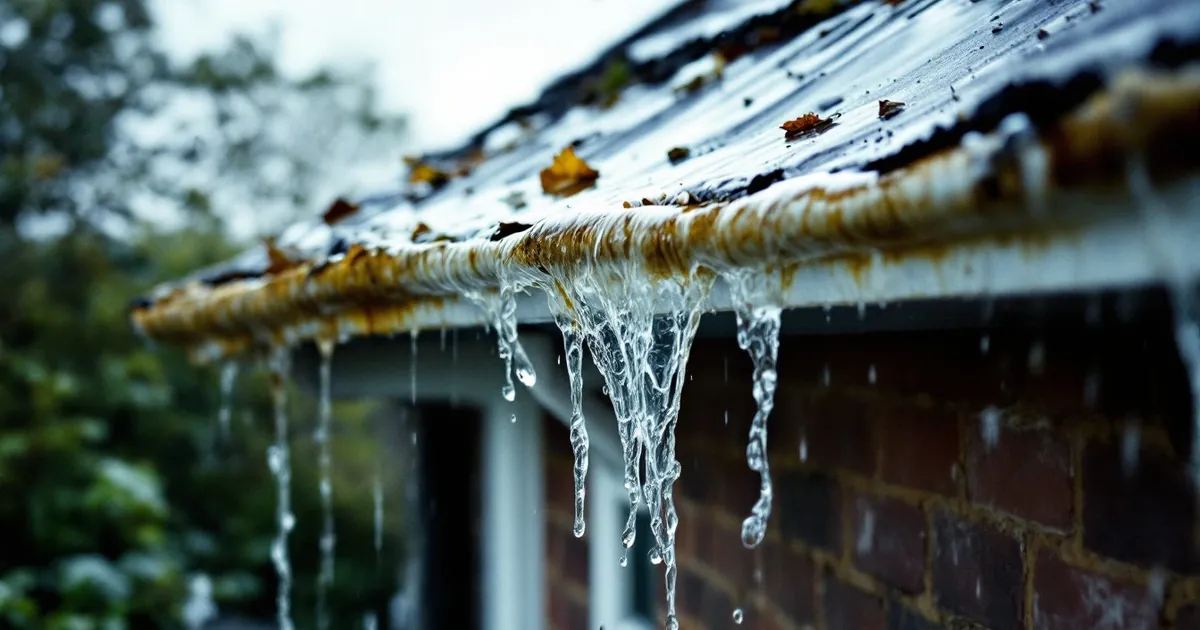
Blocked gutters cannot carry rain away, so the water goes somewhere else. Because it has no route, it spills over the edge, runs down your walls and soaks into the fabric of the house. Over months and years, that causes damp, rot and repairs that cost far more than a clean.
This guide walks through what happens, in the order it usually happens. It also shows how to stop the chain early. Each stage is easier and cheaper to fix than the next, because the damage spreads.
Stage one: the gutter fills and overflows
Leaves, moss and roof grit settle in the channel. At first the water still finds a way through. However, the debris packs down and the outlet blocks.
The next heavy shower has nowhere to go. As a result, it spills over the front edge or pours from the joints. Coventry gets about 700 mm of rain a year, so your gutters face plenty of tests.
You may notice a waterfall at the edge of the roof during rain. That is the first clear warning. Our guide to the signs your gutters need cleaning lists the rest.
Stage two: water soaks the walls
Overflowing water runs down the brickwork. Brick and mortar absorb it, so the wall stays wet for days. As a result, damp can pass through to the inside.
Damp is common, although it is slow. The Property Care Association says blocked guttering and defective fall pipes are a common cause of water ingress. Damp walls can bring peeling paint, musty smells and mould. Our post on whether blocked gutters can cause damp covers the signs in detail.
Green streaks on the brick are an early clue. They show where water has run for a long time. Similarly, dark patches under the eaves point to a leak above.
Stage three: fascias, soffits and timber rot
The fascia board carries the gutter. If water sits against it, the wood stays wet. Wet timber rots, and therefore it cannot hold the weight of a full gutter.
Soffits suffer too, since they sit directly beneath. Water can run behind the gutter and soak them from above. Paint then blisters and flakes.
Rot is hard to see until it is well advanced. For example, a board may look fine but feel soft when pressed. If you suspect it, ask for a roofline check during a clean. Our page on fascia and soffit cleaning shows what we look at.
Stage four: sagging, cracking and collapse
A gutter full of wet debris is heavy. The brackets bend under the load, and the run starts to sag. Water then pools in the low spot, while the sag grows. Water then pools in the low spot, which makes the problem worse.
In winter the trapped water freezes. Coventry sees about 39 days of air frost a year, mostly between December and March. Ice expands, so it can split joints and crack the channel.
Eventually a section may pull away from the fascia. At that point a clean is no longer enough, because the fixings have failed. You need gutter repair or, in bad cases, a replacement. Our comparison of gutter repair and replacement helps you choose.
Stage five: problems at ground level
Water that falls from a blocked gutter lands at the foot of the wall. Over time it can soften the soil and soak the base of the building. That is a slow problem, yet it is expensive to fix.
Blocked downpipes cause a similar mess. Water backs up the pipe and spills from the joints, so the wall below gets wet. Read our guide to the signs of a blocked downpipe if you see pooling at the base of a pipe.
Plants and small trees can also take root in the debris. Their roots push into joints and lift the gutter. Therefore, a gutter full of green growth needs attention soon.
Will insurance pay for the damage?
Do not rely on it, because the Association of British Insurers says home insurance is not a maintenance contract. It generally excludes damage caused by lack of maintenance.
That means a claim for water damage from neglected gutters could be refused. However, a regular clean is proof that you looked after the home. Our post on roofline features such as fascias and soffits shows what else to keep in good order.
How fast does it happen?
It depends on your trees, roof and weather. For example, gutters under heavy leaf fall can block in a single autumn. Gutters on a clean, open roof may take years to cause trouble.
The safe approach is a routine, since regular checks catch trouble early. Read how often you should clean your gutters and set a date. Then check from the ground after storms.
Local examples
Many Regency-era homes in Leamington Spa sit in a conservation area, so owners value careful upkeep. Our team covers gutter cleaning in Leamington Spa and the Nuneaton gutter service alike. Both are easy to book, and early cleans keep repairs small.
What a clean costs compared with the damage
A clean is a small, predictable cost. Typical UK prices run about £50 to £120 for a terraced house, £80 to £150 for a semi-detached and £120 to £170 for a detached house. We give a free fixed quote before any work starts.
Damage costs more and is less predictable. A typical gutter repair job costs around £100 to £250, and that is before any damp or timber work. Replacing all the guttering on a typical house in uPVC usually costs somewhere around £1,000 to £1,600.
Those figures are typical ranges, not quotes. However, the gap between them is clear. A regular clean costs less than a repair, and a repair costs less than a rebuild.
Stop the damage before it starts
A clean takes a short visit, while a repair for rot or damp can take weeks. We confirm a fixed price before any work starts, and you can see typical costs on our pricing page.
If your gutters are overdue, do not wait for the next storm. Get a free quote and we will get them flowing again.
Frequently asked questions
What happens if you never clean your gutters?
They block, overflow and soak your walls, fascias and foundations. Over time that leads to damp, rot, sagging gutters and costly repairs.
How long can gutters go without cleaning?
Most homes need a clean once or twice a year. Gutters under heavy trees can block within one autumn, so check them after leaf fall.
Can blocked gutters damage my roof?
Yes. Standing water and moss can wet the roof edge and fascia boards. Over time that can rot the timber and loosen the fixings.
Will home insurance cover damage from neglected gutters?
Often not. Home insurance generally excludes damage caused by lack of maintenance, so a claim for water damage could be refused.
- blocked gutters
- gutter maintenance
- damp
- coventry